Hello, I'm Isla, the Graduate Marketing and Fundraising Officer here at Toybox. When I first stepped into the Toybox office I had no idea just how much I was about to learn. Whilst I could share with you my lesson on how to not break the franking machine (Why are there so many buttons?), with International Day of the Street Child coming up on April 12th, I’m using this blog to share the lessons I have learnt from street children since joining Toybox. Because when I joined Toybox, what I didn’t anticipate was just how much it would shape the way I think about resilience, justice, and storytelling.
This blog is a reflection on some of the lessons I have learnt from reading countless stories from street children across the world and from hearing of the incredible dedication of our local partners who have spent decades working alongside them.
Lesson One: Resilience
One of the biggest lessons I have learned so far at Toybox is that resilience doesn’t always look the way we imagine it. The most common representation of resilience is as a big, bold act of strength in the face of what feels like insurmountable adversity. At least when I imagine resilience it’s usually linked to the story of Sisyphus - The King forced to push a heavy boulder up a steep hill for all of eternity. But reading the children’s stories, speaking with colleagues, and seeing the persistence of our partners has shown me a very different kind of resilience. A resilience that is woven into everyday moments.
For the children we work alongside, resilience often looks like showing up. Whilst this might not feel like it involves the same act of strength as Sisyphus does, to them, just showing up for school, to a registration appointment, or to a workshop run by our partners, can involve overcoming barriers that feel impossible. It involves them showing the courage to trust an adult, sometimes after years of being let down. It’s the determination to try again when systems fail and when life on the streets has taught you to expect less than you deserve. Most importantly it’s choosing despite all the challenges to try for something better. Seeing how our local partners walk alongside children for months, or even years, has deepened my understanding of just how much strength it takes to keep going in systems that aren’t designed with these children in mind.
The continued resilience of street children is a reminder that change doesn’t have to be quick to be meaningful. But that valuing progress over speed and support over self-sufficiency can in the end, make the biggest difference. Witnessing this quieter form of resilience has in many ways made me rethink the way I respond to challenges in my own life.
Lesson Two: Justice
Working for Toybox has made me much more aware of just how much inequality is built into the everyday structures most of us take for granted. When you grow up in a country where your birth is automatically recorded, it’s easy to assume that access to identity is a basic, universal right. But learning about the obstacles children face, from complex bureaucracy to financial barriers, has made me see that injustice is often hidden in plain sight.
For these children to truly have access to justice and the ability to exercise their rights, it isn’t solely about laws and court rulings, it’s about removing the specific barriers that hold each individual child back. Justice starts when we see every child as more than a part of a statistic but see them as a whole person whose life could look very different if they were simply given the chance. Something as simple as helping a child secure their birth certificate restores their rights and gives them the freedom to belong.
Lesson Three: Storytelling
Before joining Toybox, I often found myself relying on numbers to understand global issues, whether its how many children are living or working on the streets, how many are denied access to school or healthcare etc. Statistics are useful, but I’ve learned at Toybox that numbers alone can never tell the full story.
Behind every single statistic is a child. When you read a project report that says 200 children were supported to start the birth registration process, you see a figure. But when you hear the story of Mwangaza who has waited years to be recognised as a citizen of her country, or of Antonio and Pedro who had to fight through the courts to access their birth certificates, that figure suddenly becomes real.
Seeing the stories behind the statistics has reminded me that the work we do isn’t for some abstract system, but to make a difference for each individual’s journey. Some journeys are slow, some are more complex, some involve setbacks, but they all require enormous courage. The more I’ve learned about their lived experiences, the more I’ve realised how misleading it can be to think we understand a situation just because we know the numbers behind it.
Lesson Four: Meaningful Change
If there’s one thing that working for a charity that supports street children has shown me, it’s that meaningful change often begins with something small. So if you’ve connected with any part of this reflection, I’d love to invite you to take one small step with me.
That step might be spending a few minutes reading one of the children’s stories. It might be sharing something you’ve learned with a friend or donating to Toybox. Maybe you choose to learn more about the barriers street children face, or simply carry these stories with you into your day.
Every action, no matter how small, helps build a world where no child has to call the streets home. We want to see a world rooted in dignity, justice, and the belief that every child deserves the chance to belong; and being part of that change starts with caring.
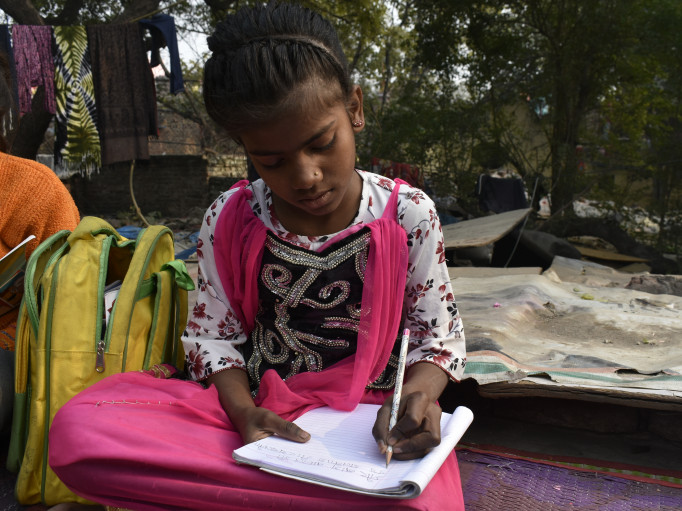
Pictured at Top of Page: Aisha practicing her writing
Read my March blog here