Smita Khanijow, Toybox's Programme Manager for Asia and Africa, shares her thoughts on how how peer-to peer collaboration is transforming street work in South Asia.
At Toybox, we believe that real, lasting change for street children happens when communities lead the way and when organisations learn from each other. That’s why we’re passionate about creating opportunities for our local partners to share knowledge, experiences, and tools with each other that work.
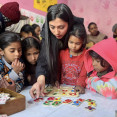
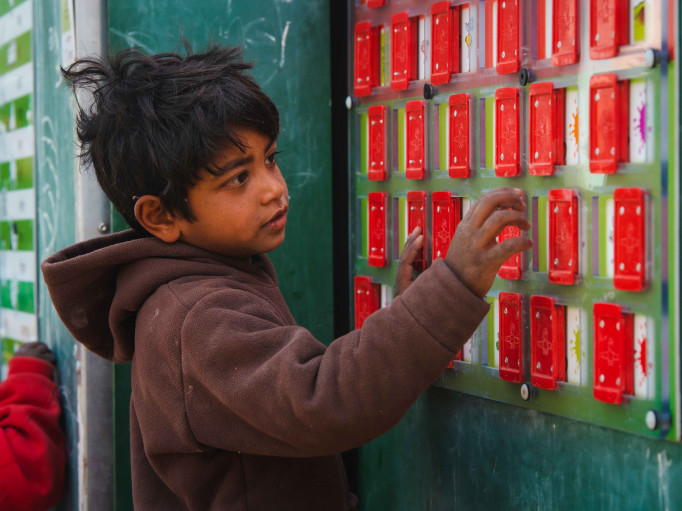
One powerful example of this is our collaboration with Mobile School (Belgium) and our local partner SathSath in Nepal. In July 2023, after months of planning and training, SathSath launched a Mobile School in Kathmandu (pictured above) — a colourful, interactive set of learning panels on wheels that brings education directly to children living and working on the streets.
The response was immediate and inspiring. Children, parents, and even local leaders were drawn to the mobile school’s vibrant design and engaging activities. But after three months, the team wanted to go deeper and learn how other organisations supporting children were using the tool and how they could make it even more impactful.
This is where peer learning came in.
Crossing borders to share ideas
As part of our ongoing support for partner peer learning, I joined the SathSath team in Nepal to help plan and accompany their learning exchange with organisations in India. Together with the SathSath team, we co-designed a learning journey to India — visiting three civil society organisations using similar tools and approaches: Aarth Aastha and CHETNA in Delhi, and Ek Tara in Kolkata.
Before the trip, we spent time in Kathmandu visiting mobile school sites, meeting families, and listening to children’s hopes for the future. It was clear: the mobile school had huge potential, but there was even more to learn.
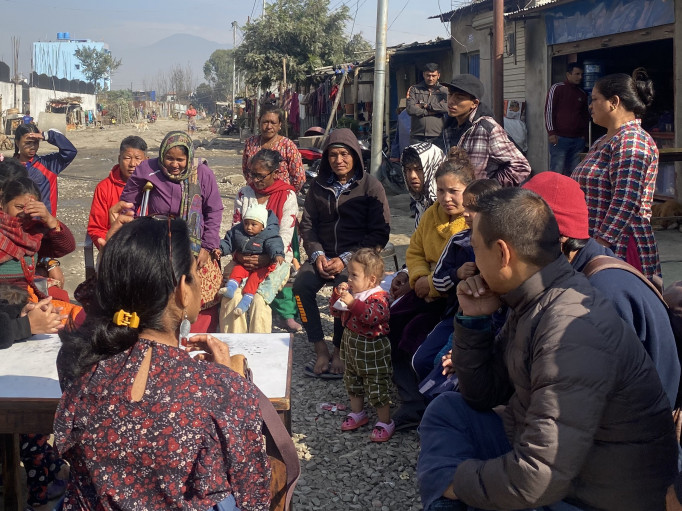
Pictured below: Smita (front left) speaking with community members in Kathmandu.
What we learned in India
In Delhi, the SathSath team saw how Aarth Aastha had evolved from a service provider to a rights-based organisation and how they were including children with disabilities in their programmes through parenting workshops and access to government support. Biso, SathSath’s Executive Director, reflected: “Nepal and India are so similar in many ways — there’s so much we can learn from each other’s successes and challenges.”
Over the next two days, the team spent time with CHETNA in the West Delhi district. Both SathSath and CHETNA have been long-term local partners of Toybox in Asia. The teams exchanged ideas on monitoring tools and community engagement. Kabita from SathSath was inspired by the idea of providing hot meals to encourage school attendance, while Asma from CHETNA was eager to learn more about the mobile school model in Nepal.
Finally, in Kolkata, the team spent three days with Ek Tara, who have been using the mobile school for over six years.
They returned to Nepal full of ideas — from expanding outreach to partnering with government schools for sustainability. Back in Kathmandu, the SathSath team began developing an adaptive project plan based on everything they learned. This journey of peer-to-peer learning not only sparked new ideas, it renewed the team’s commitment to the children they serve.
What’s happening now?
Fast forward to 2025 we are seeing the seeds of peer learning sown in December 2023 sprouting with the mobile school being fully functional and running multiple sessions across different locations in Kathmandu. The monitoring tools are child centric and capture both qualitative and quantitative information which is being used to link children with the formal education system.
At Toybox, we’re proud to support this kind of collaboration. Because when organisations learn from each other, street children benefit. And that’s what it’s all about.
Pictured below: Smita - Toybox's Programme Manager for Asia and Africa.