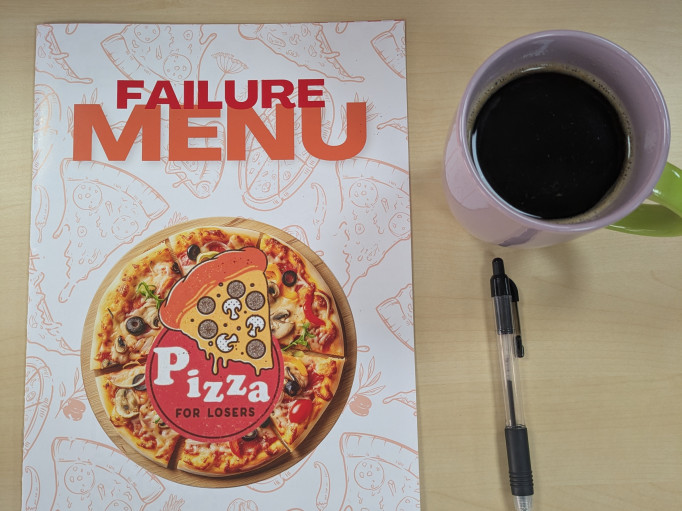
Hello, I'm Isla, the Graduate Marketing and Fundraising Officer here at Toybox. This month I'm sharing what 'failure' can mean in fundraising and how a Pizza For Losers workshop made me think differently about failing.
Working in fundraising is, at its core, about connection. It’s about helping people to see the heart of a cause and inspiring them to become part of its story. But the reality is that doing that well sometimes means stepping out of your comfort zone, trying something new, and therefore risking failure.
In fundraising you have to ask, and when you ask, there’s always a chance the answer will be “no”. You can write the perfect grant application, craft the most compelling case for support, nurture every relationship with care, and still fall short of your target.
Fundraising is one of the few professions where you can pour your heart, time, and creativity into something only to be told “no” repeatedly. Fear of failure is universal, but in the charity sector it often feels amplified. The stakes feel higher because the work is rooted in real lives and real impact. That sense of responsibility can make failure feel like something we shouldn’t talk about. But the reality is that not every project lands. Not every initiative creates the impact we imagined. And if we pretend otherwise, we lose opportunities to learn and grow.
The good news? In fundraising, every “no” often brings you closer to the next “yes” because fundraising is a long game built on mini experiments - Did the event resonate? Did the pitch connect? Did that new approach land how we hoped? Each attempt can teach us something valuable.
Pizza for Losers
At the end of January, the Toybox team took part in a workshop called “Pizza for Losers”, run by Nikki Bell. It was a refreshing and honest look at how failure can be something we learn from rather than fear. We explored different mindsets, shared personal experiences, and even heard stories from our leadership team about times they didn’t get it quite right. And of course, it’s always a win when it ends with eating pizza!
As someone at the start of my career, I found this workshop incredibly grounding. There’s a pressure that comes with being new in the working world – the feeling that you’re supposed to know everything instantly and never get it wrong. Hearing experienced colleagues speak openly about their own setbacks and learning curves flipped that narrative on its head. It was a reminder that growth doesn’t come from getting everything perfect, it comes from being courageous enough to try.
At Toybox our core value is to be courageous. It underpins everything we do. But being courageous isn’t just about the bold, attention-grabbing decisions, it’s about being unafraid to explore new ideas, and being willing to step beyond your comfort zone. Innovation requires experimentation, and experimentation requires the willingness to fail and the willingness to sit with the discomfort of the unknown. That’s why knowing we’re trusted to try (and possibly stumble) makes all the difference.
Moving Forward With What We Learn
Now, this isn’t a manifesto for expecting failure or assuming things won’t work. In fact, I plan carefully, hope for the best, and enter every project believing it can succeed (yes, I am very much an optimist!). But learning how to handle it when things do fail, can have a big impact on how willing you are to try again next time.
Reflecting on discussions at the workshop made me think about how learning to move forward after failure isn’t about shrugging it off or pretending it didn’t matter. It’s about recognising that failure is information. Yes, it shows us what didn’t work, but it also reveals what we value, what we’re capable of handling, and what we might try differently next time. Progress doesn’t come from avoiding failure instead each attempt builds a little more insight and intuition. Over time this can build to make you a better fundraiser, a more empathetic colleague, and a more flexible problem solver.
In fundraising, and any mission-driven work, there is a natural instinct to take setbacks personally. We care deeply about the outcomes, so it can feel like every “no” is a reflection of our abilities rather than a moment in a much bigger journey. But a “no” doesn’t erase the thoughtfulness of a proposal, the strength of a relationship you built, or the passion behind the ask.
So, whether you’re working on your next funding pitch, planning a new project, or simply navigating new year’s goals that haven’t quite gone to plan this year. Don’t forget that your willingness to engage, experiment, and risk a “failure”, is exactly what opens the door to the eventual “yeses”.